HOME HOME  ARTICLES ARTICLES  BIBLES BIBLES  LINKS LINKS  HERETIC HERETIC
 Tuesday 14th Nisan 31AD ~ The Crucifixion Day and Year? Tuesday 14th Nisan 31AD ~ The Crucifixion Day and Year?
Three Days and Three Nights?
~  scriptures are from the Hebraic Roots Bible, and HBR Bible Notes in italics. scriptures are from the Hebraic Roots Bible, and HBR Bible Notes in italics.
 Bible Commentaries and Notes. Bible Commentaries and Notes.
This article presents the crucifixion week, with the Passover and the crucifixion on Tuesday, 31AD.
Yahshua Messiah was placed in the tomb just before sunset,
which begins the middle day of the week (Hebrew/Jewish days begin at sunset).
The resurrection on the weekly Sabbath before sunrise, which completes three days and three nights "in the heart of the earth".
The reason for this understanding is listed in the follow sections:
The Passover - Leviticus 23:4-8
These are appointed times of YAHWEH, holy gatherings which you shall proclaim in their appointed seasons†:
In the first month, on the fourteenth of the month, between the evenings is the Passover to YAHWEH.
And on the fifteenth day of this month is the Feast of Unleavened to YAHWEH; you shall eat unleavened things seven days.
On the first day you shall have a holy gathering; you shall do no laborious work;
and you shall bring near a fire offering to YAHWEH seven days; and the seventh day shall be a holy gathering; you shall do no laborious work.
Deuteronomy 16:6
But at the place which He shall choose to cause His name to dwell there(Jerusalem),
you shall sacrifice the Passover offering at evening, at the going of the sun, at the time when you came out of Egypt.
Except the Sign of Jonah the Prophet - Matthew 12:38-41
Then some of the scribes and Pharisees answered, saying, Teacher, we desire to see a sign from You.
But answering, He said to them, An evil and adulterous generation seeks a sign, and a sign shall not be given to it,
except the sign of Jonah the prophet.
And even as "Jonah was in the belly of the huge fish three days and three nights,"
so shall the Son of Man be in the heart of the earth three days and three nights.°
Men, Ninevites, will stand up in the Judgment with this generation and will condemn it. For they repented at the preaching of Jonah, and, behold, one Greater than Jonah is here.

Prophecy of Daniel 9:24-27
Dan 9:24 Seventy weeks are decreed as to your people, and as to your holy city†, to finish the transgression, and to make an end of sins, and to make atonement for iniquity, and to bring in everlasting righteousness, and to seal up the vision and prophecy, and to anoint the Most Holy†.
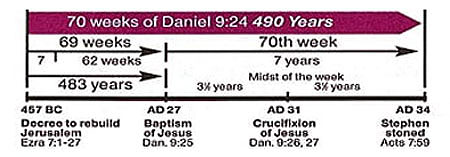
Dan 9:25 Know, then, and understand that from the issuing of the word to restore and to rebuild Jerusalem, to Messiah the Prince, shall be seven weeks and sixty two weeks. It shall be built again, with a plaza and a trench, even in times of affliction†.
This command was given by King Artaxerxes in 457 B.C.
It states after (62 + 7weeks) or 69 weeks x 7 (7 days in the week, day for a year), which would be 483 yrs, then the Messiah would appear.
This equates to the year 27 A.D. (there was no zero year), the very year Yahshua started His ministry and is one of the strongest proofs of His Messiahship.
In 27 A.D. according to Daniel's prophecy Yahshua Messiah the Most Holy, was annointed, by the Holy Spirit at His baptism.
Dan 9:26
And after sixty two weeks, Messiah shall be 'cut off H3772', but not for Himself.
Dan 9:27
And he shall confirm a covenant with the many for one week.
And in the middle of the week * he shall cause the sacrifice and the offering to cease ....
~ This has a double meaning, middle of the week, prophetically 1 week is 7 years. Middle of the week 3 1/2 years.
~ This was the length of Messiah's Ministry from 27AD until the beginning of 31AD, 3 1/3 years.
* Tuesday sunset is the start of the middle day of the Hebrew week.
NASEC - H3772
כָּרַת
karath (503c); a prim. root; to cut off, cut down:—
cease(1), chewed(1), completely cut off(1), covenanted(1), cut(10), cut down(20), cut off(57), cuts off(4), cutter(1), cut her off(1), cut him off(4), cut it down(1), cut it off(1), cut them down(1), cut you down(1), cut you off(2), cut Israel off(1), deprived(3), destroyed(1), eliminate(42), eliminated(37), kill(1), killed(1), lack(5), made(52), make(31), makes(2), making(3), perish(1).
The Week of the Crucifixion - Scriptures
Six Days Before the Passover - John 12:1.
John 12:1 Then six days before the Passover, Yahshua came to Bethany, where Lazarus was, who had died, whom He raised from the dead.
Counting six days from Thursday to Passover. - applying Jewish Inclusive Reckoning:
1 Thursday, 2 Friday, 3 Sabbath, 4 Sunday, 5 Monday, 6 Tuesday, which would mean at sunset Tuesday Passover begins, and the following day Wednesday our Messiah was crucified.
Which would mean He would be placed in the Heart of the Earth the day after the middle of the week Dan 9:26-27.
This would mean Sunday resurrection in contradict with the origin text, which states the Messiah's tomb was found empty on Sabbath morning, but supports the Nicaean Council's replacing Passover with Easter and Sunday for the resurrection.
Counting six days from Wednesday to Passover. - applying Jewish Inclusive Reckoning:
1 Wednesday, 2 Thursday, 3 Friday, 4 Sabbath, 5 Sunday, 6 Monday, which would mean at sunset Monday Passover begins, and the following day Tuesday our Messiah was crucified.
So if it was a Wednesday, then 6 days later we have the crucifixion on the Tuesday afternoon, and Messiah's body placed in the Tomb (the heart of the earth/cut off Dan 9:26-27) just before sunset which begins the middle day of the week.
Two Days Before the Passover - Matthew 26:1-2 (~ day begins at sunset)
John 12:2 Then they made Him a supper there, and Martha served. But Lazarus was one of those reclining with Him.
Mat 26:1 And it happened, when Yahshua finished all these sayings, He said to His disciples,
Mat 26:2 You know that the Passover is coming after two days, and the Son of Man is betrayed to be crucified. (Mark 14:1)
Mat 26:3 Then the chief priests and the scribes and the elders of the people were assembled to the court of the high priest, the one named Caiaphas.
Mat 26:4 And they plotted together in order that they might seize Yahshua by guile and kill Him.
Mat 26:5 But they said, Not during the Feast, that there be no turmoil among the people. (Mark 14:2)
Mat 26:6 And Yahshua being in Bethany, in Simon the potter's house, (John 12:2, Mark 14:3)
This is Saturday Evening, Sabbath finished at sunset, after two days is Passover.
Confirming this is Saturday evening, they made supper for Him John 12:2. No food is prepared on Sabbath.
Is supper after sunset?
Typical evening meal times:
Ordinary evening meals were eaten shortly after sunset. In Jerusalem, sunset varies with season, but for spring (Nisan/April) sunset is roughly 6:00–7:30 pm by modern clock, depending on latitude and year.
Religious meals (Seder/Passover) began after nightfall—i.e., enough darkness to count stars (some sources: ~45–72 minutes after sunset), though practical family practice could begin earlier.
Counting Two days from Saturday sunset to Passover. - applying Jewish Inclusive Reckoning:
1 Sunday, 2 Monday, which would mean at sunset Monday Passover begins, and the following day Tuesday our Messiah was crucified.
~ What is Inclusive Reckoning?
The common mode of counting employed in the Bible is shown to have been inclusive reckoning, that is, counting both the first and the last unit of time in calculating an interval.
Sunday Daytime.
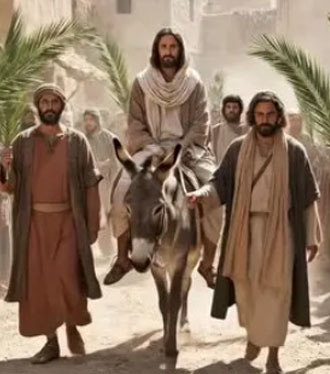
Joh 12:12 On the next day,
coming to the Feast, hearing that Yahshua is coming to Jerusalem, a great crowd
Joh 12:13 took palm branches and went out to a meeting with Him, and they were crying out, Hosanna†! "Being, blessed is the One coming in the name of YAHWEH, the King of Israel!"
Joseph Benson Commentry of the Old and New testaments
On the next day — On Sunday; much people that were come to the feast — From different parts of the country, particularly from Galilee; took branches of palm-trees, &c. — So that this multitude consisted chiefly, not of the inhabitants of Jerusalem, but of persons from other places.
John Wesley Notes on the Bible
John 12:12
The next day - On Sunday. Who were come to the feast - So that this multitude consisted chiefly of Galileans, not men of Jerusalem. Mat 21:8.
Monday before sunset.
Mar 14:12 And on the first day of the Unleavened Bread, when they killed the Passover, His disciples said to Him, Where do You desire that going we may prepare that You may eat the Passover?
Joh 13:1 And before† the Feast of the Passover, Yahshua knowing that His hour had come that He should move from this world to the Father, loving His own in the world, He loved them to the end.
Monday after sunset, 14th Nisan begins, the Passover.
Exo 12:6 And it shall be for you to keep until the fourteenth day of this month.
And all the assembly of the congregation of Israel shall kill it between the evenings.†
Luk 22:14 And when the hour came, He reclined, and the twelve apostles with Him.
Luk 22:15 And He said to them, I have greatly desired that I eat this Passover (Deut 16:6) with you before I suffer.
Luk 22:16 For I say to you that from now on, I will not eat of it again until when it is fulfilled in the kingdom of YAHWEH!
Joh 13:2 And supper having occurred, the Devil having put already into the heart of Simon's son Judas Iscariot that he should betray Him,
Tuesday 14th Nisan.
Joh 19:17 Carrying His cross beam to a place that was called The Skull, but in Hebrew is called Golgotha
Joh 19:18 where they crucified Him, and two others with Him, on this side and on that side, and Yahshua in the middle.
Joh 19:19 And Pilate also wrote a title and put it on the cross beam. And having been written, it was:† Y AHSHUA, H'NAZARENE, V MELEK (and King of), H YEHUDEIM (the Jews)
Joh 19:31 Then, since it was Preparation, that the bodies not remain on the tree on the Sabbath, for that Sabbath was a holy day†,
the Jews asked Pilate that their legs might be broken and they be taken away.
Joh 19:41 And there was a garden in the place where He was crucified, and a new tomb in the garden, in which no one yet ever had been placed.
Joh 19:42 There, then, because of the Jews Preparation day†, because the tomb was near, they put Yahshua.
Luk 23:53 And he took it down and wrapped it in a shroud of linen and laid it in a hewn tomb that which no man had yet been placed.
Luk 23:54 And the day was setting and the Sabbath was approaching†.
In the Heart of the Earth Three Days and Three Nights.
Matt 12:40 And even as "Jonah was in the belly of the huge fish three days and three nights,"
so shall the Son of Man be in the heart of the earth three days and three nights.
Tuesday sunset - Wednesday sunset - 1 day and 1 night. (cut off at the beginning of the middle day of the Hebrew week.)
Wednesday sunset - Thursday sunset - 1 day and 1 night.
Thursday sunset - Friday sunset - 1 day and 1 night.
Shabbat begins at Friday sunset, Sabbath morning just before sunrise the Tomb is found empty.
Three full days and nights.
Return to top 
Astronomical Timing - Full Moon alignment with First Day of Unleavened Bread - High Day/Sabbath.
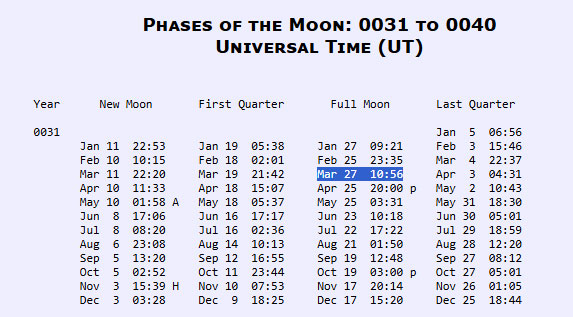
Based on astronomical calculations for the year 31 AD, the full moon of Nisan (the first full moon after the vernal equinox which was 21st March)
occurred on Tuesday, March 27, 31 AD. (Harvard University)
Astronomical Full Moon: Tuesday, March 27, 31 AD.
Passover Context: In 31 AD, this places the 14th of Nisan (Passover) on a Tuesday (Monday sunset - Tuesday sunset), and at sunset the next day begins, 15th Nisan the 1st day of Unleavened bread which always aligns with the full moon.
Return to top
Is 31AD the Correct Year of the Crucifixion? -
The Mysterious Events of the Year 31 A.D.
Roman Authorities Stop Sanhedrin Judging Capital Offences.
They stripped the Sanhedrin of its autonomous right to carry out executions.
By around 30 CE, Roman procurators had to approve any death sentence in Judea.
~ Evidence for the shift in Authority.
Roman provincial governance: As a Roman province, Judea was governed by an imperial appointee, the procurator, who held the ius gladii, or the "right of the sword," meaning the final say on capital cases.
‘The Holy Temple Revisited’ - Rabbi Leibel Reznick.
"Although this was the largest structure on top of the entire Temple Mount, the purpose and function of the Basilica is not recorded anywhere. The TALMUD tells us that when the Sanhedrin (Supreme Court) CEASED TO JUDGE CAPITAL OFFENCES, they MOVED from the Supreme Court chambers to the 'shopping mall' (Rosh HaShana 31a).
The Gospel of John (18:31) supports this idea, with the Jewish leaders telling Pontius Pilate, "It is not lawful for us to put anyone to death," when they bring Yahshua before him.
The Historical Reliability of the
Gospels/*, by Craig Blomberg, Inter-Varsity Press, 1987, p. 179
"...the claim that the Romans retained the sole right of capital
punishment (John 18:31) has often been termed a Johanine error,
especially in view of the counter-example in the stoning of Stephen
(Acts 7:58). But this right is strikingly confirmed by a passage in
the Talmud, which says that capital punishment had been taken from
the Jews FORTY YEARS before the destruction of the temple in A.D. 70
(pSanh.1:1, 7:2). Stephen's stoning reads more like mob action which
defied technical legalities"
Reasons for the Roman policy
~ Roman sovereignty:
Restricting capital punishment to the Roman governor was a way to reinforce Roman sovereignty over a restive province like Judea. This kept the ultimate authority over life and death firmly in Roman hands.
~ Maintaining order:
The Romans held that local religious councils could address local religious issues, but they were very concerned about rebellions and sedition, especially in volatile areas. Executions for religious reasons could incite unrest, so Rome kept control of capital punishments to manage public order.
Regarding the Temple.
Matthew 27:51 And, behold! The veil of the sanctuary was torn into two from above as far as below†. And the earth quaked, and the rocks were sheared!
The Life and Times of Jesus the Messiah - Alfred Edersheim
"And now a shudder ran through Nature, as its Sun had set. We dare not do more than follow the rapid outlines of the Evangelistic narrative.
As the first token, it records the rending of the Temple-Veil in two from the top downward to the bottom; as the second, the quaking of the earth, the rending of the rocks and the opening of the graves...while the rending of the Veil is recorded first, as being the most significant token to Israel, it may have been connected with the earthquake, although this alone might scarcely account for the tearing of so heavy a Veil from the top to the bottom. Even the latter circumstance has its significance. That some great catastrophe, betokening the impending destruction of the Temple, had occurred in the Sanctuary about this very time, is confirmed by not less than four mutually independent testimonies:
those of Tacitus, of Josephus, of the Talmud, and of earliest Christian tradition.
The most important of these are, of course, the Talmud and Josephus. The latter speaks of the mysterious extinction of the middle and chief light in the Golden Candlestick, forty years before the destruction of the Temple; and both he and the Talmud refer to a supernatural opening by themselves of the great Temple-gates that had been previously closed, which was regarded as a portent of the coming destruction of the Temple" (p. 610).
The Temple was destroyed by Titus in 70 A.D. Forty years before that date would be 31 A.D. - the year of the crucifixion! (Which happened at the beginning of the Hebrew year).
‘Wars of the Jews’ - Josephus.
"Thus also, before the Jews' rebellion, and before those commotions which preceded the war, when the people were come in great crowds to the feast of unleavened bread, on the eighth day of the month Xanthicus [Nisan,] and at the ninth hour of the night, so great a light shone round the altar and the holy house, that it appeared to be bright day-time; which light lasted for half and hour. This light seemed to be a good sign to the unskillful, but was so interpreted by the sacred scribes as to portend those events that followed immediately upon it. At the same festival also, a heifer, as she was being led by the high priest to be sacrificed, brought forth a lamb in the midst of the temple. Moreover, the eastern gate of the inner, [court of the temple,] which was of brass, and vastly heavy, and had been with difficulty shut by twenty men, and rested upon a basis armed with iron, and had bolts fastened very deep into the firm floor, which was there made of one entire stone, was seen to be opened of its own accord about the sixth hour of the night. Now, those that kept watch in the temple came thereupon running to the captain of the temple, and told him of it; who then came up thither, and not without great difficulty was able to shut the gate again. (IV, 5, 3).
The ‘Jewish Talmud’ in Yoma 39b, events which occurred in 31 A.D.:
"Forty years before the Temple was destroyed [ie., 40 years before 70 A.D., or in 31 A.D. by the Jewish method of inclusive counting] ...the gates of the Hekel [Holy Place] opened by themselves, until Rabbi Yohanan B. Zakkai rebuked them [the gates] saying, Hekel, Hekel, why alarmist thou us? We know that thou art destined to be destroyed..."
This same year, 31 A.D., the Sanhedrin had to abandon the Chamber of Hewn Stones, near the Holy Place in the Temple, which was its official seat or location. This was about 40 yards southeast of the entrance to the Holy Place. In 31 A.D. the Sanhedrin had to move to another location, called "The Trading Place," farther to the east and a much less significant spot. To be forced to move from a beautiful, gorgeous, awesome location in the Temple to a spot much less beautiful, esteemed, and reverential, must have seemed a terrible "put down."
~ Says the ‘Talmud':
"Forty years before the destruction of the Temple, the Sanhedrin was BANISHED (from the Chamber of Hewn Stone) and sat in the trading-station (on the Temple Mount)"
(Shabbat 15a).
‘Secrets of Golgatha’ (p. 230-231) - Ernest Martin.
"If an earthquake of the magnitude capable of breaking the stone lintel at the top of the entrance to the Holy Place was occurring at the exact time of Christ's death, then what would such an earthquake have done to the Chamber of Hewn Stones (a vaulted and columned structure) no more than 40 yards away from where the stone lintel fell and the curtain torn in two?
"There is every reason to believe, though the evidence is circumstantial, that the Chamber of Hewn Stones was so damaged in the same earthquake that it became structurally unsafe from that time forward. Something like this had to have happened because the Sanhedrin would not have left this majestic chamber (to take up residence in the insignificant 'Trading Place') unless something approaching this explanation took place"
We have a most remarkable witness that God the Father engineered every action happening on the day of Christ's trial and crucifixion. It means that the judgment made by the official Sanhedrin against Jesus within the Chamber of Hewn Stones, was THE LAST JUDGMENT ever given by the official Sanhedrin in their majestic chambers within the Temple! It would show that God the Father demonstrated by the earthquake at Christ's death that the sentence of the Sanhedrin against Jesus would be the last judgment it would ever make in that authorized place!"
Facts about The Temple Lintel and Temple Veils.
The lintel was an enormous stone, being at least 30 feet long and weighing some 30 tons! The Temple Veils were 60 feet long, 30 feet wide, and the thickness of the palm of a man's hand, wrought in 72 squares. They were so heavy that we are told 300 priests were needed to manipulate each one. The Veil being rent from top to bottom was such a terrible portent because it indicated that YAHWEH God's Own Hand had torn it in two, His Presence thus deserting and leaving that Holy Place.
Earthquake
Matthew 27:51 .... And the earth quaked, and the rocks were sheared!
Geological evidence indicates that a significant earthquake occurred in the region of the Dead Sea and Jerusalem during the early first century, with studies pinpointing a seismic event between 26 A.D. and 36 A.D.. This timeframe aligns with the estimated period of Jesus' crucifixion (often cited as 30 or 33 A.D.)
- Dead Sea Sediment Cores: A 2012 study by geologist Jefferson Williams and his colleagues, published in the International Geology Review, analyzed sediment layers (varves) from the Dead Sea.
- "Seismites" (Deformed Layers): The researchers identified disturbed sediment layers, known as seismites, at the Ein Gedi Spa site. These layers indicate a powerful,, earthquake-related shaking of the ground.
- Dating: The study found a distinct layer of deformed sediment dating specifically to this period, occurring 10 to 85 cm above an older, well-documented 31 B.C. earthquake layer.
- Intensity: While the exact magnitude is hard to confirm, the deformation suggests a "moderately strong" quake, which could have been felt in Jerusalem and caused significant disruption.
- Magnitude: While not explicitly stating the exact magnitude, studies suggest it was strong enough to cause damage in the region, with some analyses indicating a possible magnitude (M) of 6.7 or higher, with an epicenter along the Jericho fault.
Return to top
The Passover/Crucifixion to Resurrection/Firstfruits - Scriptures.
Note: (Although days are stated as we today know them, the Jewish day is from sunset to sunset,
therefore although it states Wednesday - this day began at sunset Tuesday to sunset Wednesday).
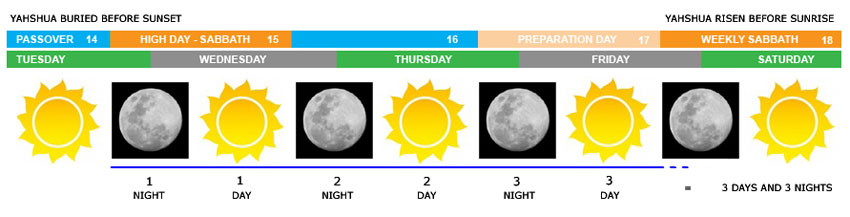
Passover - Crucifixion. (~ Tuesday - High Day Preparation)
Joh 19:31 Then, since it was Preparation, that the bodies not remain on the tree on the Sabbath, for that Sabbath was a holy day(1st day unleavened bread, not the weekly Sabbath), the Jews asked Pilate that their legs might be broken and they be taken away.
Placed in tomb just before sunset.
Joh 19:42 There, then, because of the Jews Preparation day†, because the tomb was near, they put Yahshua.
This preparation day was not Friday, but was the preparation day for the Holy day that was coming at sunset.
This was Tuesday according to the biblical calendar and Wednesday was the Holy day and Saturday the Weekly Sabbath.
Holy Gathering (~ Wednesday).
Leviticus 23:6-7 And on the fifteenth day of this month is the Feast of Unleavened...
On the first day you shall have a HOLY GATHERING ... (John 19:31 High / Holy Day)
Mat 27:62 And on the next day, which was after the sunset, the chief priests and the Pharisees were gathered with Pilate,
(~ sunset Wednesday, end of the High Day/Sabbath.)
Mat 27:63 saying, Sir, we have recalled that that deceiver while living said, After three days I will rise.
Mat 27:64 Therefore, command that the grave be secured until the third day, that His disciples may not come by night and steal Him away, and may say to the people, He is raised from the dead. And the last deception will be worse than the first.
Mat 27:65 And Pilate said to them, You have the guards. Go and take precautions as you know.
Mat 27:66 And they departed and took precautions by the grave and set a seal upon that stone together with the guards.
Mar 16:1 And the Sabbath (~ High Day) having passed, (~ now Thursday)
Mariam Magdalene and Mariam the mother of Jacob and Salome, bought spices, so that coming they might anoint Him.
Preparation Day (~ Friday).
Shabbat Day (~ 7th Day of the week).
Messiah Risen. after sunset, the beginning of Sabbath (~ 72 hours later - 3 days and 3 nights)
Mat 28:1 But after the Sabbaths†, at the dawning into the first of the Sabbaths†,
Mariam of Magdalene and the other Mariam came to look upon the grave.
John 20:1 But on the first of the Sabbaths †, Mariam Magdalene came early to the tomb, darkness yet being on it.
And she saw the stone had been removed from the tomb.
John 20:17 Yahshua said to her, Do not touch Me, for I have not yet ascended to My Father.
But go to My brothers and say to them, I am ascending to My Father and your Father, and My Elohim, and your Elohim.
Sunday (~ First-Fruits)
Lev 23:11 then he shall wave the Omer before YAHWEH for your acceptance†;
on the morrow of the Sabbath (~ 1st day of the week, Sunday) the priest shall wave it.
Joh 20:19 Then it being evening on that day, the first of the Sabbaths, (~ At Sunset on Sabbath, now the first day of the week, the Firstfruits)
and the doors having been locked where the disciples were assembled because of fear of the Jews,
Yahshua came and stood in the midst and said to them, Peace to you.
What is Meant by “first of the sabbaths”
First of the sabbaths is the first of seven weekly Sabbaths in the count to Pentecost (or Shavuot) Leviticus 23:15-17.
Traditional Jews of Yahshua's time celebrated Pentecost (or Shavuot) on the fiftieth day after the waving of the firstfruits. (Firstfruits coincided with the Feast of Unleavened Bread.) The firstfruits wave offering consisted of a sheaf of barley, the first crop of the spring growing season. This early growing season ended seven weeks later with the cutting of the wheat harvest, and for that crop, a different kind of offering was decreed.
Return to top
The Resurrection - Mis-Translation of the Original Text :
First day of the Week or First of the Sabbaths
KJV Matthew 28:1
In the end of the sabbath, as it began to dawn toward the first day of the week, came Mary Magdalene and the other Mary to see the sepulchre.
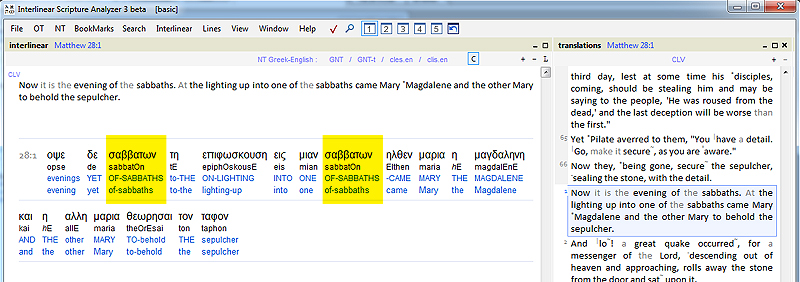
HBR Matthew 28:1
But after the Sabbaths†, at the dawning into the first of the Sabbaths†, Mariam of Magdalene and the other Mariam came to look upon the grave.
Interlinear Scripture Analyzer Matthew 28:1
KJV Mark 16:2
And very early in the morning the first day of the week, they came unto the sepulchre at the rising of the sun.
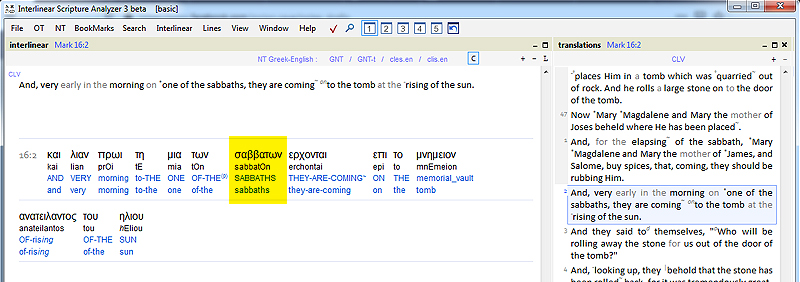
YLT Mark 16:2
and early in the morning of the first of the sabbaths, they come unto the sepulchre, at the rising of the sun,
Interlinear Scripture Analyzer Mark 16:2
KJV John 20:1
The first day of the week cometh Mary Magdalene early, when it was yet dark, unto the sepulchre, and seeth the stone taken away from the sepulchre.
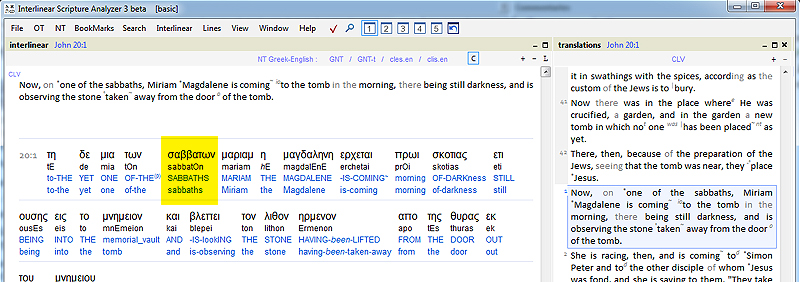
HBR John 20:1
But on the first of the Sabbaths, Mariam Magdalene came early to the tomb, darkness yet being on it. And she saw the stone had been removed from the tomb.
Interlinear Scripture Analyzer John 20:1
King James Version+ Bible
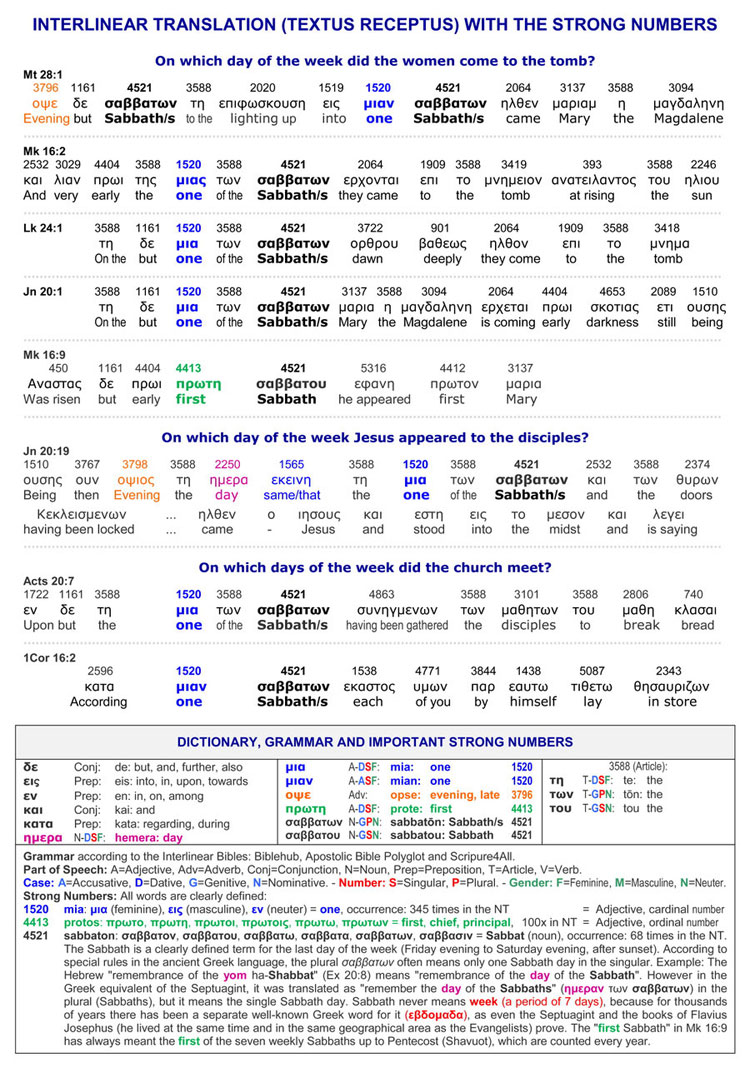
Matthew 28:1 In the end(G3796) of the sabbath,G4521 as it began to dawnG2020 towardG1519 the firstG3391 day of the week,G4521 cameG2064 MaryG3137 MagdaleneG3094 andG2532 theG3588 otherG243 MaryG3137 to seeG2334 theG3588 sepulchre.G5028
G4521 - σάββατον - sabbaton
Thayer Definition:
1) the seventh day of each week which was a sacred festival on which the Israelites were required to abstain from all work
1a) the institution of the sabbath, the law for keeping holy every seventh day of the week
1b) a single sabbath, sabbath day
2) seven days, a week
Part of Speech: noun neuter
A Related Word by Thayer’s/Strong’s Number: of Hebrew origin H7676
Return to top
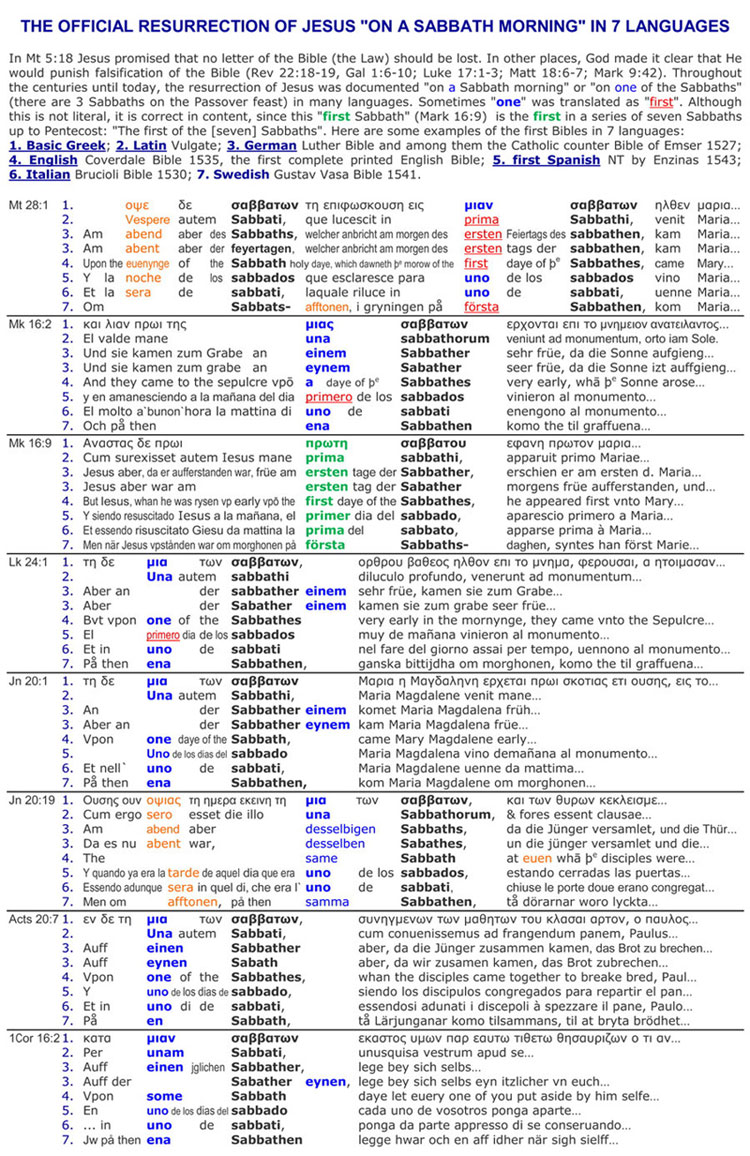
The official resurrection of Yahshua Messiah "on a Sabbath morning" in 7 languages
Throughout the centuries until today, the resurrection of Yahshua was documented "on a Sabbath morning" or "on one of the Sabbaths" (there are 3 Sabbaths on the Passover feast) in many languages. Many German Catholic Bibles even spoke of "a Saturday morning" when the women went to the grave.
Sometimes the word "one" was translated as "first". Although this is not literal, it is correct in content, since this "first Sabbath" (Mark 16:9) is the first in a series of seven Sabbaths up to Pentecost. Therefore this phrase “on the first of the Sabbaths” is also correct.
Here are the first Bibles translations into 7 languages:
1. Basic Greek text
2. Latin Vulgate
3. German Luther Bible and among them the Catholic counter Bible of Emser 1527
4. English Coverdale Bible 1535, the first complete printed English Bible
5. first Spanish NT by Enzinas 1543
6. Italian Brucioli Bible 1530
7. Swedish Gustav Vasa Bible 1541
Return to top
Textus Receptus - Interlinear Translation with Strong's Numbers - Resurrection on Sabbath Morning: Greek ~ English
Return to top
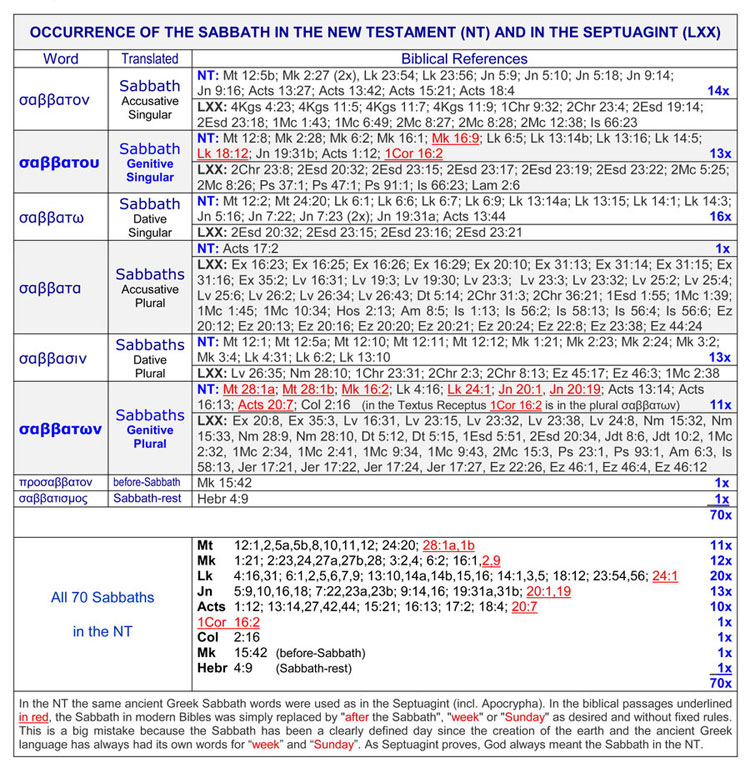
Septuagint - Sabbaths in the New Testament - Resurrection Yahshua Messiah on Sabbath Morning, .
Return to top
And even as "Jonah was in the belly of the huge fish three days and three nights,"
so shall the Son of Man be in the heart of the earth three days and three nights. ~ Matthew 12:40
Why Three days and Three nights?
“It is a proverb in the Talmud and the Targum, that corruption sets in the third day after death”
(Tholuck after Wetstein).
Why did Jesus leave Lazarus for dead for 3 days & 3 nights?
Lazarus becomes ill
When Lazarus of Bethany, the village of Mary and her sister Martha, become ill, they sent for Jesus. But when Jesus heard of the need, he said, “This illness does not lead to death. It is for the glory of God, so that the Son of God may be glorified through it.” It was an additional two days before Jesus said to His disciples that they should go to Lazarus, even though He knew that Lazarus was now dead. And by the time Jesus does arrive, Lazarus had been dead four days.
This is another significant miracle what would point towards Jesus being the Messiah, yet would also lead to his crucifixion and physical death. It was extremely significant that Lazarus had been dead 4 days as Judaic law taught that through to the third day, the spirit remained with the body and there was hope of resuscitation to life.
Yahshua Raises Lazarus Joh 11:38-44
Then groaning again within Himself, Yahshua came to the tomb. And it was a cave, and a stone was placed upon its entrance.
And Yahshua said, Take this stone away! Martha, the sister of the dead man, said to him, My Master, it is the fourth day. He stinks already!
Yahshua said to her, Did I not say to you that if you would believe you will see the glory of YAHWEH?
Then they took away the stone where the dead one was laid. And Yahshua lifted His eyes upward and said, Father, I thank You that You heard Me.
And I know that You always hear Me, but because of the crowd that stands here, I said it, that they might believe that You sent Me. And saying these things, He cried out with a loud voice, Lazarus! Come Forth!
And that dead man came out while his hands and his feet were bound in bandages, and his face bound in a head cloth! Yahshua said to them, Untie him and allow him to go!
The last Messianic miracle was performed when Yahshua raised Lazarus from the dead.
The scriptures had already recorded that both Elijah and Elisha raised the dead.
However, Yahshua raising Lazarus from the dead after the fourth day in the grave was truly a miracle.
Lange, J. P., & Schaff, P. (2008). A commentary on the Holy Scriptures:
John (p. 356). Bellingham, WA: Logos Bible Software.
Jewish mysticism teaches that a deceased person’s spirit remains around the body for up to three days after death before departing. It was well-known in Israel 2,000 years ago that someone deceased could come back to life during this 3-day period but not afterwards.
On the fourth day, the spirit left the body and went to Sheol or Hades, and there was no hope for life without a miracle. Also, by the fourth day in Israel’s hot climate, advanced decay would be destroying the body and the stench would have been overwhelming. When Jesus called Lazarus to life from the dead and healed his rotted corpse, the people knew that He was the true Messiah, performing genuine miracles as the prophets had foretold!
The Kabbalists speak of Hibbut Ha-Kever, a three to seven-day process of separating the nefesh portion of the soul from the body. The Zohar states: “For seven days the nefesh goes to and from his house to his grave from his grave to his house, mourning for the body…and it grieves to behold the sadness in the house.” This is the reason for immediate burial of the deceased. Jewish folklore suggests that the soul will become confused and linger around the body for those three to seven days. The body must be laid to rest, so the soul can move on and find peace in the afterlife. In his book "Jewish Views of the Afterlife," Simcha Paull Raphael says: "Immediately following death, there is a period known as Hibbut Ha Kever, pangs of the grave. During this period, the soul is confused, lingers around the body and tries to go back to his home to be with his loved ones. After this, there is a maximum period of 12 months in Gehenna, which is a realm described as fiery, where the soul is purified of its sins." After the twelve-month period, it is believed the soul rests permanently in the afterlife.
Jewish Law's Legal Stipulation
At the time of the crucifixion Jewish law had an important legal stipulation. This stated that a person was not legally dead until a full three 24-hour day’s had passed i.e. 72 hours.
The Hebrew culture’s sense of timing was and as far as I know still different from ours.
This is certain during the time of the disciples who would have kept to Hebrew timing.
“On the Third Day”
Several passages in the Midrash Rabbah, which tie into the Mishnah, suggest a third-day motif could have been latent throughout a Jewish understanding of the dead. These laws are especially relevant to the passion narrative of Jesus, possibly inspiring the very idea that he was raised “on the third day.” The key passage is as follows, based on Job 14:22:
Bar Kappara taught: Until three days [after death] the soul keeps on returning to the grave, thinking that it will go back [into the body]; but when it sees that the facial features have become disfigured, it departs and abandons it [the body]. (Genesis [C:7 (994)])
This is corroborated by the repeated principle that the identity of a corpse could only legally be established by the corpse’s “countenance” within three days, after which it became too disfigured for identification by that means. The law stated that “You cannot testify to [the identity of a corpse] save by the facial features together with the nose, even if there are marks of identification in his body and garments: again, you can testify only within three days [of death].”[*1] And in the Midrash, these two ideas were clearly linked:
For three days [after death] the soul hovers over the body, intending to re-enter it, but as soon as it sees its appearance change, it departs, as it is written (Job 14:22), “When his flesh that is on him is distorted, his soul will mourn over him.” Bar Kappara said: The full force of mourning lasts for three days. Why? Because [for that length of time] the shape of the face is recognizable, even as we have learnt in the Mishnah: Evidence [to prove a man’s death] is admissible only in respect of the full face, with the nose, and only [by one who has seen the corpse] within three days [after death]. (Leviticus [XVIII:1 (225-226)])
The idea that the soul rests three days in the grave before departing is also casually assumed in the Midrash Rabbah on Ruth [III:3 (43-44)] and Ecclesiastes [I:34 (41-42)]. Confirming this belief is a passage in the Semahot, which says:
One may go out to the cemetery for three days to inspect the dead for a sign of life, without fear that this smacks of heathen practice. For it happened that a man was inspected after three days, and he went on to live twenty-five years; still another went on to have five children and died later. (8.1)
Thus, it was considered possible for a soul to reunite with its body within three days, but no more, for sometime on the third day the soul realized the body was rotting, and then departed.[*2] Thus, a resurrection on the third day reverses the expectations of the Jews: to physicalists, instead of departing, the soul of Jesus reunites with his body and rises; to spiritualists, instead of departing, the soul of Jesus is exalted by God, raised to his right side, thence to appear in visions to the faithful. Either way, a resurrection before the third day might not be a true resurrection, but a mere revival, or the ghost of a not-yet-departed soul, but a resurrection on the third day is true evidence that death was in either sense defeated. This “third day” tradition in Jewish law may in fact be very ancient, possibly lying behind the prophecy of Hosea, “He will revive us after two days, He will raise us up on the third day, that we may live before him” (6.2), and no doubt had something to do with Paul’s conviction that Jesus “was raised on the third day according to the scriptures” (1 Corinthians 15:4).
[*1] Mishnah, Yebamot 16:3a-e. For examples of this law being cited, cf. Midrash Rabbah, Genesis [LXV:20(595)], [LXXIII:5(669-670)] and Leviticus [XXXIII:5].
[*2] cf. Zlotnik’s endnote regarding the corrupted reading of “thirty days” in some texts. He demonstrates on palaeographical grounds that “three days” is clearly the correct reading here. This also fits the other passages, and makes far more sense: it is inconceivable that someone would remain alive in a tomb for thirty days.
Conclusion
Easter is pagan feast, and Our Messiah was not crucified on Easter, or a Friday.
The less than 36 hours between crucifixion and resurrection before sunrise Sunday morning, has zero biblical support.
Passover can be any day of the week, but always on the 14th day of Nisan, the first month of the Biblical year.
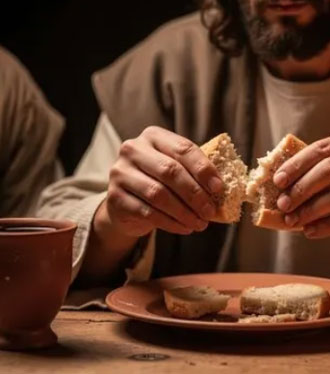
It was at this very time of the Passover, Yahshua Messiah replaced the symbols of the Passover, the sacrificial lamb (which covered sin), with Him being the perfect sacrifice, atoning for sin once and for all. And for us as a memorial, unleavened Bread and Wine, representing His sinless broken body and His blood.
He never replaced the day or time of Passover, nor does scripture teach weekly/monthly or quarterly communion or any form of it.
The scriptures also state Paul kept and taught others to keep all of the Holy Times and Sabbaths.
Exodus 12:14 And the day shall be a memorial for you.
And you shall celebrate it as a feast to YAHWEH, for your generations. You shall celebrate it as a law forever.†
~ Exodus 12:14 The day of Passover shall be celebrated forever. However, YHWH has the prerogative to change the symbols of the Passover as He did in the New Covenant using bread and wine to symbolize the slain blood of the Lamb of Yah.
Summary of the presented evidence:
- The prophecy of Daniel 9:24-27,
- The scriptures of the days before Passover and crucifixion,
- Astronomical timing of the full moon,
- Historical evidence of events from 31AD,
- The resurrection of Messiah "on a Sabbath morning" in 7 languages,
- The Septuagint, Textus Receptus and Strong's numbers stating Sabbath morning resurrection,
- Legal requirements to be counted dead according to Jewish law at the time,
- Taking Messiah's words literally, which are specifically stated as a sign,
- Historical accounts leading up to the council of Nicaea, and what was changed/banned in favour of Easter,
What is presented supports the understanding that,
the day and year that our Master Yahshua Messiah was crucified,
~
was Tuesday 14th Nisan (27th* March) 31AD.
That Yahshua Messiah was in "the heart of the earth" for "three literal days and three literal nights",
And was "Risen before Sabbath sunrise 18th Nisan", as the Tomb was found empty before dawn,
as it was originally written.

Our Passover is Messiah - 1Corinthians 5:7
Then clean out the old leaven so that you may be a new lump, just as you are unleavened†.
For our Passover is Messiah† who was sacrificed for our sake.
Genesis 2:2 And on the seventh day Elohim completed His work ...
John 11:25 And Yahshua said ... I AM the Resurrection and the Life†.
~ And on the seventh day Yahshua completed His work ...
Return to top
HOME ARTICLES BIBLES LINKS HERETIC |

.
.
.
|